Dadoes and Rabbets: Essential Joinery Techniques
Dadoes and rabbets have gotten less attention than sexier joinery like dovetails, but as someone who has built a lot of cabinets and shelving over the years, I can tell you these two joints do more actual work in a shop than almost anything else. Once they clicked for me — how they distribute load, where each one belongs, how to cut them cleanly — my cabinet work improved dramatically. Today, I will share it all with you.
What is a Dado?
A dado is a rectangular groove cut across the grain of a board. It has three sides — the bottom and two walls — and accepts another piece of wood that drops in to create a strong mechanical joint. The mating piece doesn’t need glue to hold; the dado does the structural work by capturing the piece along its entire width.
Types of Dados
- Through Dado: Runs edge to edge across the full width of the workpiece. Fastest to cut, but the groove shows at both edges when the piece is assembled.
- Stopped Dado: Doesn’t extend all the way to the front edge, keeping the joint hidden from the front. Requires a corresponding notch on the mating piece. A cleaner look for visible casework.
Tools for Cutting Dados
- Table Saw: The most common setup for production dado cutting. A stacked dado blade set cuts the full width in a single pass. Fast and consistent once the setup is dialed in.
- Router: More flexible than a dado stack for stopped dados and non-standard widths. Use a straight bit with a fence or guide bushing. My preferred approach for one-off cuts and stopped dados.
- Dado Plane: Traditional hand tool for cutting dados, still used by hand-tool woodworkers. Slower but quiet and produces a clean result in straight-grained wood.
Applications of Dados
That’s what makes dados so useful to bookshelf and cabinet builders — they capture shelves positively rather than relying entirely on fasteners. A shelf in a dado can’t sag downward under load; the dado wall takes the load directly. Cabinet dividers, drawer bottom captures, and carcass construction all rely heavily on dado joinery. Took me about three bookshelves before I started cutting dados consistently and stopped wondering why my shelves shifted under load.
What is a Rabbet?
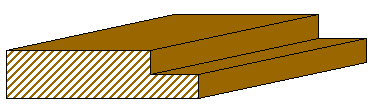
A rabbet is a two-sided, open recess cut along the edge of a board. It creates an L-shaped step that accepts another piece of wood in a lap configuration. Unlike a dado, one side of the rabbet is open — it runs to the edge of the board. Rabbets are strong and add structural integrity to panel assemblies.
Types of Rabbets

- Single Rabbet: Cut along one edge to accept a mating piece. The most common configuration for back panels, door stops, and edge joints.
- Double Rabbet: Cut along both edges of the piece, often used in frame-and-glass construction for doors and windows where the glass needs to be captured from both sides.
Tools for Cutting Rabbets
- Table Saw: A dado stack or two passes with a standard blade can cut a rabbet efficiently. Fast for production work.
- Router: A rabbeting bit with a bearing guide makes consistent rabbets along any edge. Very practical for long runs or curved edges.
- Rabbet Plane: Hand tool for precise rabbet work, especially useful for fitting back panels or fitting glass stops where a slight adjustment makes the difference.
Applications of Rabbets
Cabinet backs are the most common application — the back panel drops into rabbets cut in the case sides and top, sitting flush or recessed behind the face frame. Glass panel installation in door frames uses rabbets to capture the glass from behind. Edge joining in furniture uses rabbets to create stronger connections than a simple butt joint allows. I’m apparently someone who cuts the cabinet back rabbet first thing on every carcass build — it sets the reference for everything else.
Combining Dados and Rabbets
Frustrated by weak shelving units that flexed under load, woodworkers started combining dado and rabbet joinery in the same carcass — using dados for intermediate shelves and rabbets at the top and bottom where the case sides meet the horizontal components. The technique caught on and evolved into the standard casework construction approach that cabinetmakers rely on today.
Strength and Durability
These joints distribute load and stress across the full gluing and mechanical surface area rather than concentrating it at fasteners. The interlocking nature makes assembled carcasses significantly more rigid than butt-jointed or pocket-screwed alternatives. This is why bookcase shelves in dado joints hold loads that would cause pocket-screwed versions to deflect.
Precision and Fit
The fit of a dado or rabbet joint is what determines whether it looks and functions like fine furniture or rough carpentry. A snug sliding fit — where the mating piece seats fully without forcing and without rattle — is the goal. Too tight and you’ll crack the piece during assembly; too loose and the joint loses both strength and appearance. Sneak up on the final dimension with test cuts in scrap.
Common Mistakes and How to Avoid Them
- Incorrect Measurements: Measure the actual thickness of the mating piece, not the nominal dimension. A “3/4 inch” plywood panel is almost never actually 3/4 inch. Measure and cut to fit what you actually have.
- Using the Wrong Tool: Dull dado blades and worn router bits produce torn grain and rough walls. Sharp tooling is non-negotiable for clean dado and rabbet work.
- Ignoring Wood Movement: In solid wood construction, allow slight play in dadoes to accommodate seasonal movement. A dado that’s too tight in winter will split the carcass in summer.
Advanced Techniques
Once comfortable with basic through dadoes and rabbets, stopped dadoes open up cleaner casework where the joint is entirely hidden from the front. Rabbeted edges combined with tongue-and-groove profiles add more sophistication to panel construction. Specialty configurations like sliding dovetails — a dado with dovetailed walls — add both strength and resistance to the joint pulling apart under tension.
Using Jigs and Templates
Jigs for dado work make production cutting consistent and fast. A crosscut sled with dado-width stop blocks lets you cut multiple matching dados without re-measuring. Router jigs with guide rails produce perfectly parallel and identically sized stopped dadoes across multiple pieces. For drawer series in cabinets, jigs are what make all the drawer bottoms land at the same height without individual layout work.
Decorative Dados and Rabbets
Exposed joints can become design elements rather than things to hide. A router with a decorative profile bit can add a chamfer or roundover to the edge of a dado joint where it’s visible, turning a utilitarian connection into an aesthetic detail that elevates the piece.
Materials and Wood Types
Hardwoods produce cleaner dado walls and hold tighter joints — oak, maple, and cherry cut crisply with sharp tooling. Softwoods like pine are easier to work but the grain tears more readily; sharp bits and proper feed direction matter more in softwood. The payoff in fit quality is worth the attention either way.
Working with Plywood and MDF
- Plywood: Most cabinetry uses plywood for carcass parts. Cut dados to the actual measured thickness. The edges may need edge banding if exposed.
- MDF: Cuts cleanly and holds a consistent width across the full thickness. More stable dimensionally than plywood for dado construction, but heavier and less strong in shear.
Choosing the Right Adhesives
PVA wood glue is standard for dado and rabbet joints. Apply a thin, even coat to both mating surfaces, assemble, and clamp until cured. For repairs or when fitting mixed materials, epoxy provides a stronger gap-filling alternative. The mechanical fit of the joint does most of the structural work — glue reinforces and seals it.
Maintenance and Repair
Well-made dado and rabbet joints hold for decades without attention. If joints loosen over time from seasonal movement or heavy use, reapplying wood glue with clamping pressure usually restores them. More significant looseness may warrant reinforcement with screws through the side panel into the shelf edge — positioned where they’ll be hidden by the face frame.
Master these two joints and you have the foundation for nearly all box and carcass construction. Dados and rabbets aren’t glamorous, but they’re what separates furniture that holds together for fifty years from furniture that wobbles after five.

Stay in the loop
Get the latest wood working workshop updates delivered to your inbox.