Dremel vs Angle Grinder — Which Rotary Tool Does Your Woodworking Need?
The dremel vs angle grinder debate has gotten complicated with all the conflicting advice flying around woodworking forums. I understand the impulse — both tools spin accessories at high speed, both technically qualify as rotary tools, and if you’re trying to justify a single purchase, you want a straight answer. Don’t make my mistake. I bought an angle grinder first because it seemed like the more powerful, more serious tool. Spent the next six months unable to do the detail inlay work I actually needed. These tools aren’t competitors fighting for the same territory. They operate at completely different scales, and that changes everything about how you choose between them.
This article includes affiliate links. We may earn a commission at no extra cost to you.
Dremel vs Angle Grinder — They Don’t Actually Compete
But what is the real difference here? In essence, it comes down to scale and precision. But it’s much more than that.
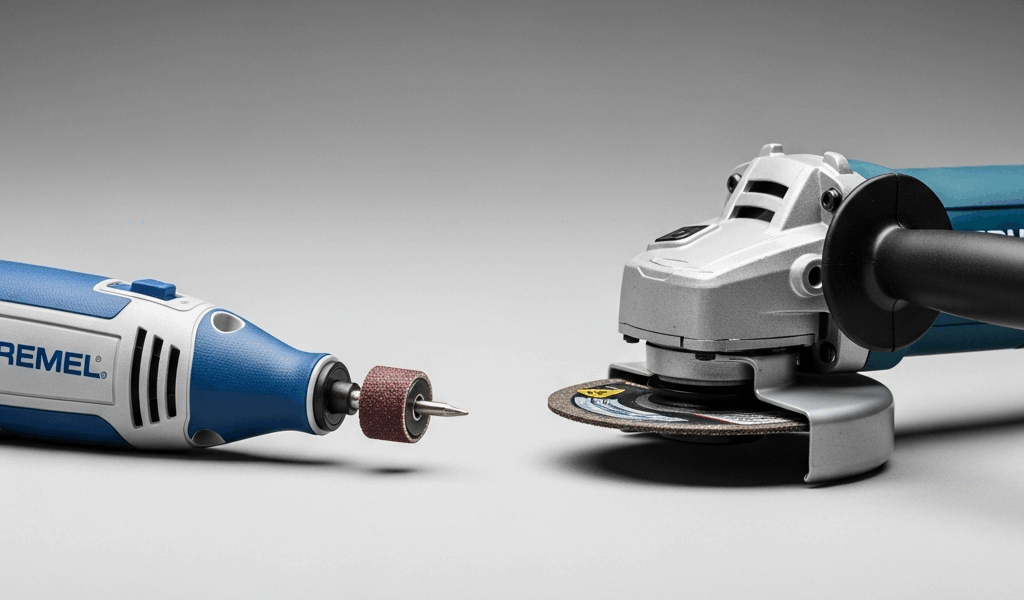
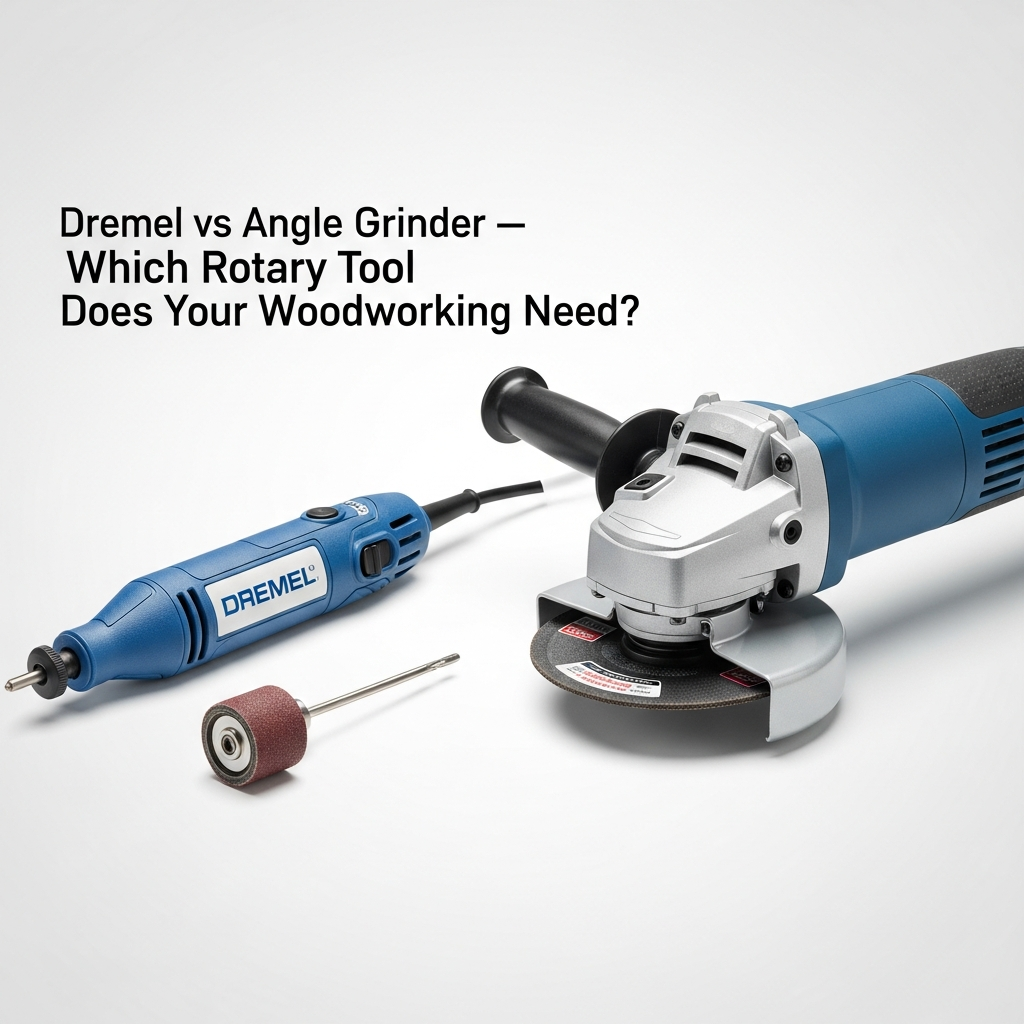
A Dremel rotary tool runs between 5,000 and 35,000 RPM — accessories ranging from roughly 1/4-inch to 1-1/2-inch in diameter. Tiny carbide burrs. Small sanding drums. Miniature cutting discs. A standard angle grinder, meanwhile, runs at 10,000 to 12,000 RPM and takes 4-inch to 7-inch discs. That’s not a minor variation. That’s a completely different category of tool wearing a similar disguise.
A Dremel at 30,000 RPM with a 1/8-inch carbide burr removes wood in a space the size of a pencil eraser. Precise, controlled, almost surgical. An angle grinder with a 4-1/2-inch carving disc removes material across a surface roughly the size of your palm — aggressively, with authority. One is a scalpel. The other is closer to a chainsaw. Debating which to buy is like arguing over whether to purchase a chisel or a drawknife. Both are sharp. Both remove wood. That’s approximately where the comparison ends.
Ask yourself one question before buying anything: what scale of work are you actually doing? That answer resolves most of this debate on its own.
What a Dremel Does Best in the Workshop
As someone who has spent years doing lutherie and small-scale furniture work, I learned everything there is to know about how indispensable a Dremel becomes for fine detail tasks. I once needed a 1/8-inch slot cut for a shell inlay in a guitar headstock — reached for my Dremel 4300 and had it finished in about twelve minutes. Clean, controlled, exactly where I needed it. Nothing else in my shop could have done that without risking the surrounding wood.
That’s the Dremel’s territory — work that’s small, precise, and happening in places bigger tools physically cannot reach. Here’s where it genuinely earns its bench space:
- Carving and engraving fine details — lettering, decorative motifs, relief textures in wood surfaces
- Cutting small slots and recesses for inlay work — shell, metal wire, contrasting wood strips
- Cleaning up joinery in tight corners — a small sanding drum gets into spots a chisel leaves rough
- Sanding curved profiles that a random orbital or belt sander simply can’t follow
- Routing shallow recesses for hardware — a 1/4-inch router bit in the Dremel handles modest inset work cleanly
The model you choose matters. The Dremel 4300 — around $100 to $120 — is the corded workshop workhorse. It accepts the widest accessory range and holds stable speed through extended sessions. If cordless appeals to you, the Dremel 8260 might be the best option, as cordless rotary work requires consistent power delivery under load. That is because brushless motor technology, combined with a 12V lithium battery, actually delivers it — something earlier cordless Dremels honestly struggled with. I was skeptical before I switched. I’m not anymore.
The flex shaft attachment deserves a specific mention here — attach it to any Dremel and suddenly you’re holding something that behaves like a dental drill handpiece. All the motor weight stays on your bench. You manipulate just a lightweight flexible wand. For detailed carving or engraving, this changes the experience entirely. Control improves dramatically. Fatigue basically disappears. It runs about $20 and I’d call it essential, not optional.
What an Angle Grinder Does in the Workshop
Probably should have opened with this section, honestly. Most woodworkers underestimate the angle grinder until they actually watch someone use one with a proper wood carving disc — then they immediately want one.
The standard use cases — cutting metal hardware, grinding welds on steel components, cleaning up metal parts for mixed-material builds — those are obvious angle grinder jobs. But the reason serious wood carvers keep one around is the carving disc workflow. That’s what makes the angle grinder endearing to us woodworkers who thought it had no place in the shop.
Frustrated by how long hand tools took to rough out large sculptural forms, craftsmen started adapting angle grinders using aggressive disc attachments — products like the King Arthur Tools Lancelot and the Arbortech Ball Gouge. The Lancelot is essentially a miniature chainsaw blade mounted as a disc. It removes large amounts of wood fast. Sculptors and spoon carvers use these to establish rough shapes in minutes that would otherwise consume an hour of hand tool work. This new approach took off several years later and eventually evolved into the wood carving disc workflow enthusiasts know and rely on today.
Safety here is not negotiable. Carving discs kick back — hard, without much warning. Both hands on the tool, firm stance, full attention. Work away from your body. Face shield, not just glasses. Nothing above shoulder height freehand. This is not a distracted-workshop tool. Used correctly, though, it’s genuinely impressive for large-scale roughing.
While you won’t need a professional-grade industrial grinder, you will need a handful of reliable options — Makita and DeWalt both make solid 4-1/2-inch models in the $60 to $90 range that handle everything a woodworking shop realistically throws at them.
When You Need Both
The most useful application I’ve found for running both tools together is large-scale wood carving — specifically the roughing-to-refining pipeline that sculptors actually use in practice.
First, you should start with the angle grinder and a carving disc — at least if you want to establish a rough form without spending half your day on it. Remove bulk material fast. Get the general shape in place. Then pick up the Dremel with a carbide burr or small sanding drum and work the details — refine the curves, define surface texture, clean up transitions between planes. The angle grinder creates a rough shape in ten minutes that would take two hours by hand. The Dremel handles the finish work the angle grinder is simply too large and aggressive to manage.
Mixed-material projects are the other scenario where both earn their keep. Knife making, tool handles, furniture with metal accents — the angle grinder handles the metal components, the Dremel handles wood detail work and cleanup. They divide the labor cleanly and neither one is doing a job it’s poorly suited for.
The Verdict — Which to Buy First
Buy the Dremel first. Full stop, for a woodworking shop.
The detail work a Dremel handles — inlay slots, fine carving, tight-space sanding, joinery cleanup — comes up constantly, and nothing else replaces it well. An angle grinder has no equivalent for those tasks. Get the Dremel 4300 if you work at a bench and want a corded tool with maximum accessory compatibility. Choose the Dremel 8260 if you want cordless operation, a brushless motor, and its connected controls.
Add the angle grinder when either of two things happen: you start doing metalwork with any regularity, or you want to try large-scale wood carving and want the roughing speed a carving disc provides. At that point, a Makita or DeWalt 4-1/2-inch grinder in the $70 range is the addition that rounds out a genuinely versatile shop setup.
These tools don’t compete for the same jobs — apparently that’s the part most forum debates miss entirely. The woodworker who figures that out buys both eventually, then wonders what took so long.

Stay in the loop
Get the latest wood working workshop updates delivered to your inbox.