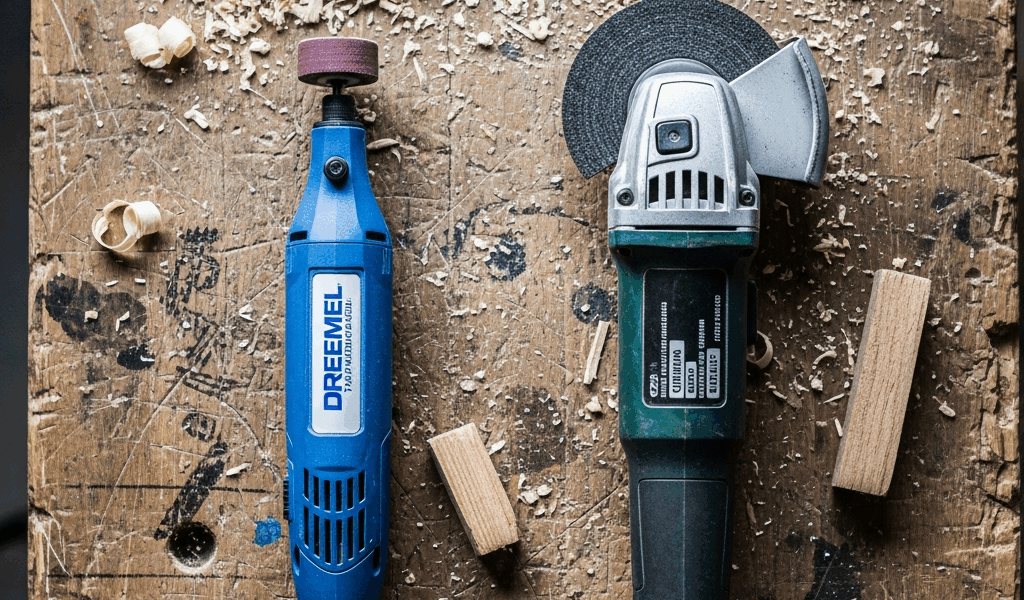
You’ve got a project that needs material removed and you’re looking at two tools in the shop: a Dremel rotary tool and an angle grinder. They both spin. They both cut. But grabbing the wrong one for the job means either not enough power or way too much — and the latter usually involves sparks, a ruined workpiece, or both.
These tools overlap less than people think. Here’s when to use which.
What a Dremel Does Well in Woodworking
A Dremel is a precision tool. The small collet accepts bits from 1/32 inch up to 1/8 inch, and the variable speed range (typically 5,000 to 35,000 RPM) gives you control over delicate work. For woodworking, the Dremel excels at detail carving, inlay routing, engraving, sanding in tight spaces, and cleaning up small joints.
Think of the Dremel as a finishing tool and a detail tool. Carving a decorative pattern into a guitar body, cleaning out a hinge mortise, smoothing an inside curve on a scroll saw project — that’s Dremel territory. The tool weighs a few ounces and you can hold it like a pen for precision work.
What the Dremel can’t do: remove material fast. Trying to shape a large workpiece with a Dremel is like trying to mow a lawn with scissors. It’ll work eventually, but your patience will run out first.
What an Angle Grinder Does Well in Woodworking
An angle grinder is raw power. A 4.5-inch angle grinder with a carving disc or flap wheel removes wood fast — aggressively fast. Shaping a chair seat, sculpting a bowl blank, removing bark, or carving large curves in thick stock are all jobs where the grinder’s power is an advantage.
Wood carving discs like the Kutzall and King Arthur’s Tools line turn an angle grinder into a rapid material removal tool that chainsaw carvers and furniture makers use regularly. A coarse Kutzall disc on a grinder will hog off wood faster than any other handheld tool.
The tradeoff is control. An angle grinder with a carving disc is not a precision instrument. It removes material fast and somewhat unpredictably — one slip removes more than you intended. The learning curve is steep, and the consequences of losing focus are real. Eye protection, face shield, and heavy gloves are not optional.
When to Use Which
Use the Dremel for: Detail carving and engraving. Sanding in tight spots. Cleaning out mortises and joints. Inlay work. Any task where precision matters more than speed. If the area you’re working on is smaller than your palm, reach for the Dremel.
Use the angle grinder for: Rapid shaping and sculpting. Removing bark or rough stock. Carving large concave surfaces like bowls or seats. Any task where you need to remove a lot of material quickly and will refine the surface later with other tools.
Use both (in sequence) for: Projects that require rough shaping followed by detail work. A carved wooden bowl, for example, starts with the angle grinder for the rough shape and finishes with the Dremel for smoothing and detail work. Many carvers use exactly this workflow.
They’re not competing tools — they’re different tools for different stages of the same kind of work. The mistake is thinking one can replace the other. A Dremel is a scalpel. An angle grinder is a machete. Both have their place in the shop, and neither does the other’s job well.


Stay in the loop
Get the latest wood working workshop updates delivered to your inbox.