
Why 12V Drills Are Worth a Spot in Any Woodworking Shop
I’ve been assembling cabinets and furniture for about a decade now, and the 12V drill question is one of those things that took me a while to figure out. Once it clicked, though, I kept a dedicated 12V alongside my bigger drill for the rest of my career. Here’s what I know.
The 18V and 20V drills get all the attention, but 12V drills occupy a genuinely useful niche: they’re compact, light, and precise enough for tasks where a bigger drill creates problems. Driving screws into thin wood joints without splitting them, installing cabinet hardware in tight spaces, drilling pilot holes in delicate stock — these are all better with a 12V. The reduced torque that seems like a limitation is actually an asset when you’re working in softwoods or thin plywood where over-driving screws turns a clean joint into a stripped disaster.
What to Actually Look For
Not all 12V drills are built the same. The features that actually matter for woodworking:
Clutch Settings: More clutch positions mean finer torque control. That’s the whole game when driving screws into wood — you want the screw seated, not stripped or overdriven. Look for 15 settings minimum; better models run 20 or more. I’m apparently a clutch-obsessive person — I’ve returned drills that didn’t give me enough resolution at the low end.
Chuck Type: Most 12V drills use a 3/8″ keyless chuck, which handles the full range of woodworking bits. Some come with a 1/4″ hex chuck for fast bit changes, which is convenient but limits your bit selection. For general workshop use, the 3/8″ chuck is the right call.

Speed Settings: Two-speed transmissions let you choose between high torque at low speed for driving screws and higher speed for drilling. Single-speed drills work fine but sacrifice flexibility.
LED Work Light: Sounds like a gimmick until you’re driving screws inside a cabinet carcass with the door basically closed around you. Then it becomes essential.
Bosch PS31-2A: Best Overall for Woodworking
The Bosch PS31-2A is what I’d recommend to most woodworkers without hesitation. At two pounds, it’s one of the lightest drills in its class, and the 265 inch-pounds of torque handles every woodworking fastening situation I’ve thrown at it. The 20+1 clutch settings give genuinely fine control — the difference between a hardwood screw seated perfectly and one with a stripped head is often a single clutch position on this drill.
The two-speed transmission runs 0-350 RPM and 0-1,300 RPM. The compact head gets into places that larger drills simply can’t reach, which matters more than you’d think when working inside casework.
- Motor: 265 inch-pounds of torque
- Battery: Includes 2 Lithium-Ion batteries
- Speed: 0-350 RPM (low) and 0-1,300 RPM (high)
- Weight: 2.0 pounds (bare tool)
- Best for: Precision work, furniture assembly, tight spaces
DeWalt DCD710S2: Most Versatile Option
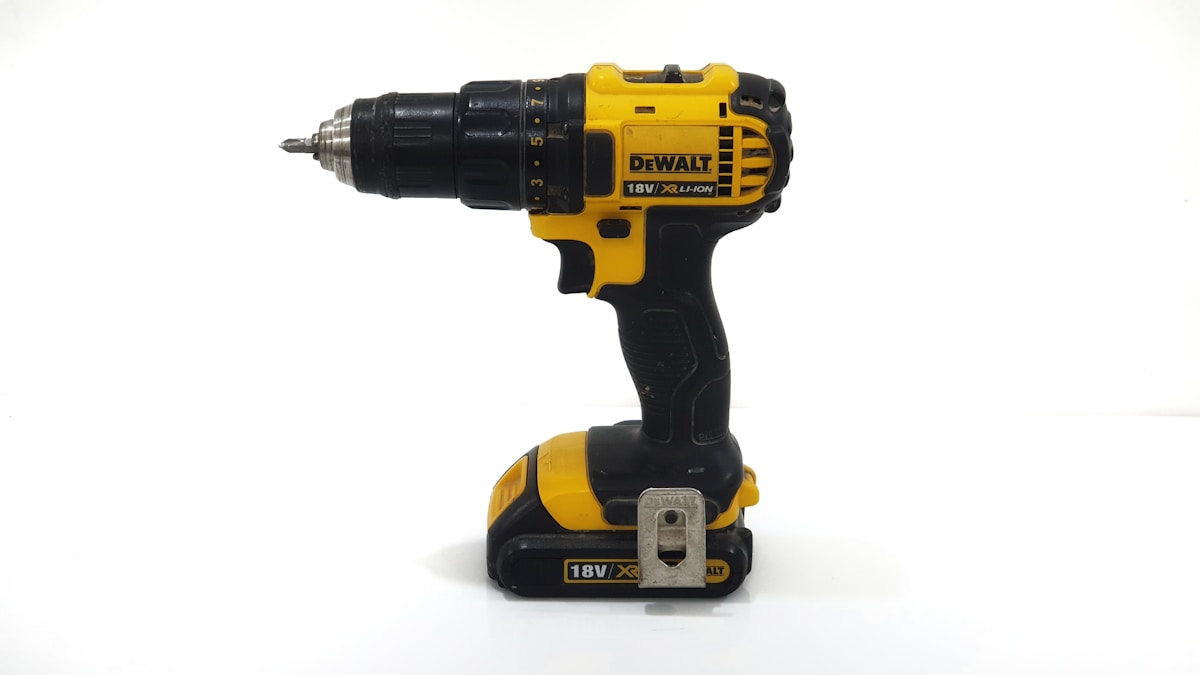
DeWalt’s DCD710S2 brings the brand’s professional-grade build quality to the 12V category. Fifteen clutch settings and a two-speed transmission at 0-400 RPM and 0-1,500 RPM covers the full range of woodworking tasks. The higher top speed gives it a slight edge for drilling over the Bosch.
What sets this drill apart is the all-metal transmission housing. My shop buddy swears by DeWalt partly because he’s been running their tools hard for fifteen years without issues — the build quality reputation is earned. The LED activates when you pull the trigger, right when you need it.
- Motor: 189 unit watts out power
- Battery: Two 12V MAX Lithium-Ion battery packs included
- Speed: 0-400 RPM and 0-1,500 RPM
- Weight: 2.4 pounds
- Best for: All-around workshop use, durability
Makita FD10R1: Best for Quick Bit Changes
The Makita FD10R1 takes the 1/4″ hex chuck approach, trading bit variety for speed of changes. If your workflow involves constantly switching between a drill bit and a driver bit — which happens constantly in furniture assembly — the tool-free swap is genuinely useful. Pull back the collar, swap, release. Takes about three seconds.
The FD10R1 also has the highest top speed of the group at 1,700 RPM and delivers 245 inch-pounds of torque. At 2.2 pounds it sits in a comfortable middle ground between the lightest and heaviest options. Wish I’d known about this one when I was doing high-volume assembly work — the bit-change speed alone would have saved real time.
- Motor: 245 inch-pounds of max torque
- Battery: 2 genuine Makita 12V max CXT Lithium-Ion batteries
- Speed: 0-450 RPM and 0-1,700 RPM
- Weight: 2.2 pounds
- Best for: Repetitive tasks requiring frequent bit changes
Milwaukee 2407-22: Best Torque Performance
Milwaukee’s 2407-22 leads the class in raw power at 275 inch-pounds of torque. That extra margin is real when you’re driving long screws into dense hardwoods — the difference between the drill handling it cleanly and having to switch to a bigger tool. The all-metal chuck grips bits better than plastic alternatives, which I noticed after switching back and forth between this and a cheaper option.
The M12 battery platform is the other argument for Milwaukee: if you already own M12 tools, this drill drops right into your existing ecosystem. Batteries are interchangeable across the whole M12 line, which adds up to real value over time.
- Motor: 275 inch-pounds of torque
- Battery: Two M12 REDLITHIUM batteries included
- Speed: 0-400 RPM and 0-1,500 RPM
- Weight: 2.1 pounds
- Best for: Hardwood projects, users in Milwaukee ecosystem
Black+Decker BDCDD12C: Best Budget Option
The Black+Decker BDCDD12C handles basic woodworking tasks at roughly half the price of the premium options. The 11-position clutch prevents most screw stripping situations, and for straightforward assembly work on softer materials, it performs reliably. The single-speed motor and fewer clutch positions mean less precision control than the top picks.
This one makes sense as a dedicated driver for a shop that already has other drilling tools, or for occasional woodworkers who don’t want to invest heavily before knowing if the hobby sticks.
- Motor: 12V motor (torque not specified)
- Battery: 1 Lithium-Ion battery included
- Speed: Single-speed (0-550 RPM)
- Weight: 2.7 pounds
- Best for: Budget-conscious buyers, occasional use
Ridgid R82005: Best Warranty
Ridgid’s Lifetime Service Agreement covering the tool, batteries, and charger for life — when registered — is the headline here. For woodworkers who use their tools constantly, the math on that warranty works out favorably. Performance-wise, the R82005 delivers 300 inch-pounds of torque and 18 clutch settings, matching or exceeding most competitors. The two-speed gearbox and built-in LED check all the standard boxes.
- Motor: Up to 300 inch-pounds of torque
- Battery: 1 Hyper Lithium-Ion battery included
- Speed: 0-400 RPM and 0-1,500 RPM
- Best for: Long-term value, warranty-conscious buyers
Making Your Choice
For most woodworkers, the Bosch PS31-2A is the easiest recommendation — the combination of light weight, excellent clutch control, and compact design makes it the right tool for furniture assembly and cabinetry. If power for dense hardwood work is the priority, Milwaukee’s torque advantage is worth it. Budget buyers can start with the Black+Decker and step up later. Ridgid buyers are really investing in the warranty as much as the tool.
Whatever you choose, a quality 12V drill earns its spot on your bench quickly. Once you’ve used one for a full cabinet project, you’ll understand why so many woodworkers keep one dedicated to driving while a bigger drill handles the heavy work.


Stay in the loop
Get the latest wood working workshop updates delivered to your inbox.