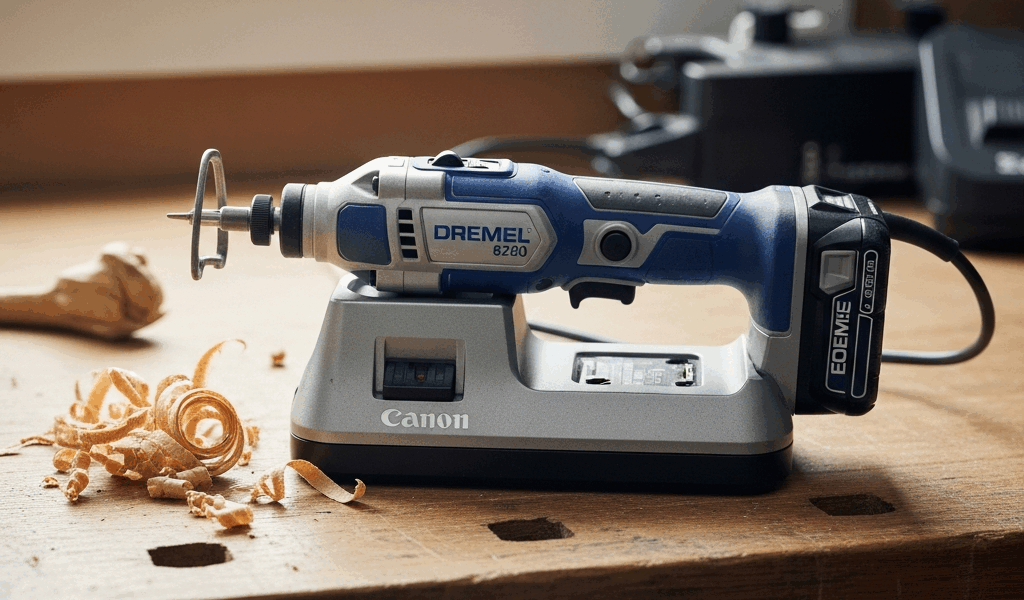
The Dremel 8260 Has Gotten Complicated With All the Hype Flying Around
As someone who’s owned a Dremel 8220 for three years — using it roughly twice a month for detail carving, inlay work, and occasional light sanding on figured wood — I learned everything there is to know about whether the 8260 is actually worth your money. Today, I will share it all with you.
When the 8260 landed at $159 street price, I spent two weeks putting it through real woodworking conditions. Here’s the short version: if you already own an 8220 and you’re doing occasional hobbyist work, don’t upgrade. If you’re choosing between the two for the first time and you plan extended carving sessions — anything pushing past 30 minutes of active cutting — the 8260 earns its $50 premium. The difference isn’t night and day. But it’s real, and I felt it in my hands.
Two things actually separate these tools: a brushless motor and Bluetooth speed control through an app. Everything else — the collet system, bit compatibility, overall form factor — is functionally identical. Most reviews online just recite specs without telling you whether the thing deserves your money. I’m not doing that here.
Brushless Motor — What It Actually Changes
But what is a brushless motor, really? In essence, it’s a motor design that eliminates the physical carbon brushes that transfer electrical current in traditional motors. But it’s much more than that — it’s the reason the 8260 feels different in your hand during detail work.
Both tools deliver 5,000 to 35,000 RPM. Same range on paper. The brushless design in the 8260 means fewer moving parts generating friction and heat, which matters more than the spec sheet suggests.
For woodworking specifically — maple, cherry, walnut — I typically run around 10,000 to 15,000 RPM for detailed carving passes. At those speeds, my three-year-old 8220’s brushed motor felt slightly inconsistent. Torque delivery would fluctuate, like the brushes were catching microscopically. Not catastrophic. Just noticeable. The 8260 holds steady pressure without that micro-stuttering. Your hand feels it immediately, especially on tight curves.
High-RPM sanding above 25,000? Honestly, both tools perform identically up there. The motor type stops mattering because you’re not running at those speeds long enough for brush wear to factor in anyway.
The real win is longevity. Brushed motors traditionally need brush replacement around every 40 to 50 hours of use. I’ve never actually replaced the brushes on my 8220 — I haven’t pushed it that hard — but knowing the 8260 doesn’t need it ever is one less thing to track five years from now. Don’t underestimate that.
Does the brushless motor handle hardwood without bogging? Yes. Both models do, honestly. The limitation isn’t the motor — it’s heat buildup during sustained high-load work past the hour mark. The 8260 gets warm slower, but neither tool is built for industrial-grade continuous use. Plan your sessions accordingly.
Battery Life and the 12V Platform
Here’s where I expected the biggest advantage. Here’s where I was partially wrong.
The 8260 runs on a 12V lithium-ion pack — same platform as the 8220, actually. Batteries from one model fit the other. That’s a genuine convenience. Charge time from dead to full on the included charger runs about 60 minutes.
Active runtime during real woodworking? I clocked roughly 45 minutes of continuous medium-RPM carving before the 8260 triggered its low-power cutoff. My 8220 managed maybe 38 to 40 minutes under identical conditions — though that battery is three years old now and holds less charge than it used to. Important context. A fresh 8220 battery would probably close that gap significantly.
Brushless efficiency does help. You’re not getting dramatically longer runtime, but you’re not losing it either. On a single charge, doing typical stop-and-start detail work with natural breaks, the 8260 handles a full morning shop session without a top-up. The 8220 does the same, for what it’s worth.
One frustration — and I mean genuine frustration. Dremel hasn’t opened the 12V platform to their broader tool lineup. These batteries don’t cross-compatible with the 4000 or older corded models. If you own multiple Dremels, you’re carrying two separate chargers. That’s a poor ecosystem decision, and I’m apparently someone who notices that kind of thing while standing at a cluttered workbench. Don’t make my mistake — check what you already own before assuming the batteries will play together.
The Bluetooth App — Gimmick or Genuinely Useful
Probably should have opened with this section, honestly.
Dremel’s app lets you control speed from your phone. Does a woodworker actually use it mid-session? Rarely. Your hands are occupied holding the tool and steadying the workpiece. Grabbing a phone while carving is just inefficient. The physical dial on the tool — identical on both models — is faster and more tactile every time.
Where the app earns its keep: saved presets. You can store custom RPM profiles for specific bits and carving styles, then recall them with one tap instead of manually adjusting the dial every session. I’m apparently someone who swaps between a #105 engraving cutter and a 115 high-speed cutter constantly, and having preset speeds for each saves maybe 10 seconds per change. Not revolutionary. But real.
The app also logs runtime and battery health data. Occasionally useful for tracking maintenance. Not a reason to spend money on this tool.
One honest assessment: the app is a checked box on a press release. It’s not why the 8260 costs more. The brushless motor is why the 8260 costs more. That’s what makes the motor story endearing to us woodworkers — it’s a tangible improvement, not a software feature that requires your phone to have 30% battery.
8260 vs 8220 — The Actual Upgrade Decision
So, without further ado, let’s dive into the comparison that actually matters:
- Price difference: $50–$70 depending on current sales
- Motor: Brushless (8260) vs. brushed (8220)
- Battery: 12V Li-Ion on both — same physical platform
- RPM range: Identical, 5,000–35,000
- Bits and accessories: Fully compatible across both models
- App control: 8260 only — minimal real-world value for most users
If you own an 8220 right now and it works fine: keep it. Full stop. The 8260 does not justify spending $150 as an upgrade from a functioning tool. Your existing 8220 will serve you for years still.
First, you should buy the 8260 — at least if you’re making this choice from scratch and plan extended carving sessions over 30 minutes, or if rock-solid torque consistency at low speeds matters to your work. The brushless motor delivers that. The 8220 might be the better option if you’re doing occasional light detail work and sanding, as the 8220 requires only a modest budget. That is because occasional hobbyist use never stresses a brushed motor enough to reveal its limitations.
While you won’t need professional-grade industrial hardware, you will need a handful of realistic expectations about what incremental improvements look like. The 8260 is a genuine improvement. An incremental one. I’d upgrade if I were doing semi-professional client carving work — the motor reliability and consistent low-RPM performance matter when your reputation depends on the tool performing. For hobbyist work, which is where I sit, the 8220 handles everything I throw at it.
The $50 difference buys you a better motor. Not a dramatically different tool. Don’t let the price tag rewrite that sentence for you.

Stay in the loop
Get the latest wood working workshop updates delivered to your inbox.