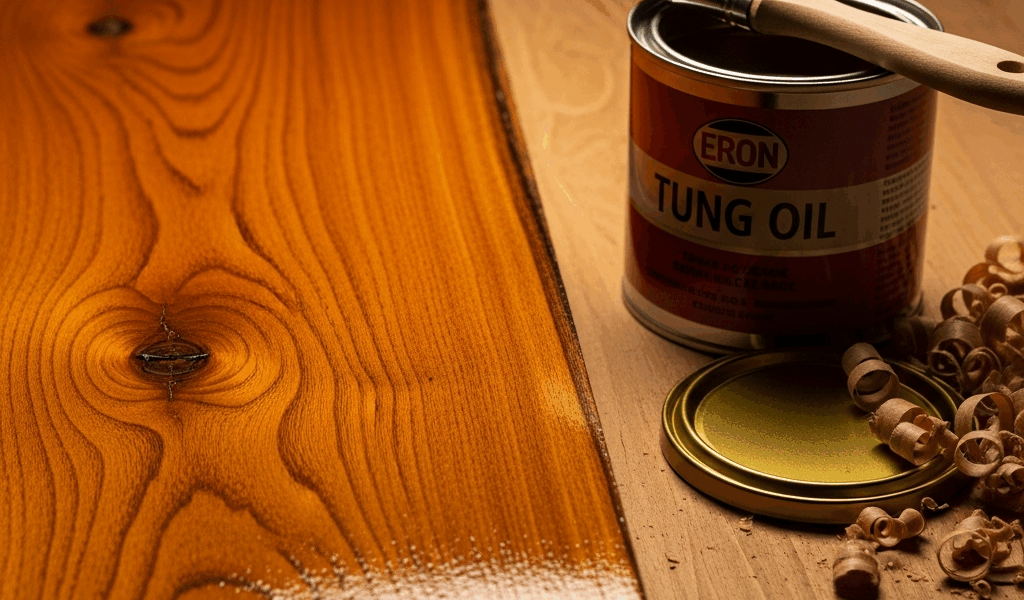
Tung Oil Finish — How to Apply It Right the First Time
I spent three years thinking I understood how to apply tung oil. Turns out, I was making a fundamental mistake that most woodworkers make: I was treating pure tung oil and commercial tung oil finish products as interchangeable. They aren’t. Not even close.
This distinction matters more than you’d think, especially when you’re staring at a freshly milled board wondering what finish will actually protect it. The confusion exists because nearly every finishing article online blurs the line between these two completely different products. I’m here to separate them.
Pure Tung Oil vs Tung Oil Finish — Not the Same Thing
Let me be direct: pure tung oil and commercial tung oil finish products are fundamentally different materials that behave differently on wood.
Pure tung oil is exactly what it sounds like—100% natural oil extracted from the nuts of the tung tree. Nothing else. No varnish, no solvents, no additives. You can eat off a surface finished with pure tung oil. Not that you should make a habit of it, but you could.
The trade-offs are brutal, though. Pure tung oil takes 30+ days to fully cure. Between coats, you’re waiting 24 hours minimum. That means a proper multi-coat finish—and you need multiple coats—requires more patience than most of us have.
Tung oil finish products (Minwax Tung Oil Finish, Formby’s Tung Oil Finish, and similar brands) are blends. They contain tung oil mixed with varnish, solvents, and driers. The manufacturer has already engineered these products to cure faster and build protection more quickly.
Here’s the practical difference: I can finish a piece of furniture with Minwax Tung Oil in 3 days and have it ready to use. With pure tung oil, I’m looking at a month-long commitment. Both have their place. Both have legitimate use cases. But they require completely different application methods.
Probably should have opened with this section, honestly. Most people don’t realize this distinction exists until they’ve already bought the wrong product and wondered why their timeline made no sense.
How to Apply Pure Tung Oil
Applying pure tung oil correctly requires patience and a specific technique. I learned this the hard way after my first attempt created a sticky, uneven mess.
What you’ll need:
- Pure tung oil (I use Sutherland Welles, which runs about $28 for 16 oz)
- Food-grade citrus solvent (like D-Limonene) for thinning
- Clean cotton rags or lint-free cloths
- Measuring cup or small container
- 400-grit sandpaper
- Gloves (pure tung oil doesn’t wash out of skin easily)
The first coat—thinning is critical.
Mix pure tung oil with citrus solvent in a 50/50 ratio. This is non-negotiable for the first coat. Straight, undiluted tung oil sits on top of the wood instead of soaking in. You want penetration, not a surface coating.
Apply this thinned mixture liberally with a rag, working with the grain. Spread it generously. This isn’t about creating an even coat at this stage—it’s about saturation. Let it soak for 30 to 40 minutes. The wood will absorb what it needs.
After that waiting period, wipe off all excess. And I mean all of it. This is where I failed the first time. I left too much oil sitting on the surface thinking more protection was better. It created a sticky, tacky finish that took weeks to stop feeling weird.
Set the piece aside for 24 hours. The oil is curing, though it’s still far from done.
Coats two through seven—the grind.
After 24 hours, the surface will feel slightly raised. Light sand it with 400-grit paper—barely any pressure needed. You’re just scuffing the surface, not removing material. Wipe away all dust with a tack cloth.
For coat two and beyond, you can apply pure tung oil straight from the can. No dilution needed now. Apply a thin coat with a rag, wait 30 minutes for partial absorption, then wipe off the excess again. This routine repeats.
I typically apply 5 to 7 coats for projects that see actual use—cutting boards, tables, anything with food contact. Decorative pieces might get away with 3 or 4. Each coat adds depth and protection.
The math on timing: if you’re doing one coat per day, your project is two weeks in before you’re even done applying. Then you wait 30 days for full cure. A cutting board finished in March isn’t ready for heavy use until May.
Is it worth the wait? For surfaces you’ll touch constantly—a wooden spoon, a cutting board, a dining table—yes. The finish feels alive. The wood ages beautifully. After a year, it develops a patina that’s impossible to fake with faster finishes.
How to Apply Tung Oil Finish Products
Commercial tung oil finish products operate on an entirely different timeline, which is why they’ve become the default choice for furniture makers who have actual deadlines.
What you’ll need:
- Minwax Tung Oil Finish or equivalent ($12–$18 per quart)
- Natural bristle brush or lint-free rag
- 400-grit sandpaper
- Drop cloth
- Gloves
Application is straightforward.
Apply a thin coat directly from the can using either a brush or rag. The product already contains solvents, so no thinning is necessary. You want coverage, not saturation. Brush out any drips or heavy spots immediately.
This dries to touch in 2–4 hours. True hardness takes longer, but you can handle the piece after 4 hours without worrying about fingerprints.
Once dry, sand lightly with 400-grit paper. This step is optional according to most labels, but I always do it. Sanding reveals any missed spots and creates tooth for the next coat. You’ll notice dust from the finish itself—this is normal and expected.
Apply a second coat exactly like the first. Some products recommend a third coat. Two coats typically provide adequate protection for furniture. Three coats give you more water resistance and durability.
Wait 24 hours after the final coat before putting the piece into service. That’s total elapsed time from can-opening to usage: roughly 30 hours instead of 30+ days.
The finish will continue to harden over a week or so, but it’s functional immediately.
Which to Choose for Your Project
The choice between pure tung oil and commercial tung oil finish depends almost entirely on your timeline and what the piece will do.
Use pure tung oil for:
- Cutting boards and food contact surfaces (it’s food-safe after full cure)
- Projects where wood feel matters—spoons, handles, anything you hold regularly
- High-touch items where natural patina is desirable
- Situations where you have 6+ weeks before the piece needs to be used
Use commercial tung oil finish for:
- Furniture that needs protection quickly
- Trim, doors, and architectural elements
- Items that see moderate to heavy use (tables, desks)
- Projects with normal timelines and deadlines
- Pieces where water resistance matters more than natural feel
I made a cutting board from walnut with pure tung oil last year. It gets used constantly, and the surface has developed character that no factory finish could replicate. Would I finish a client’s dining table the same way? Absolutely not. The timeline would be impossible, and the client wouldn’t understand why they need to wait six weeks before they can actually sit at their new table.
Common Application Mistakes
Having finished dozens of pieces both ways, I’ve seen these errors more often than I’d like to admit.
Not wiping off excess. This is the most common mistake with pure tung oil. Excess oil left on the surface creates a sticky, gummy feel that never fully goes away. Every coat, remove all excess after the waiting period. This is non-negotiable.
Applying the first coat too thick. Thick application on that initial coat doesn’t help—it prevents proper penetration. That 50/50 thinned mixture is deliberate. It’s designed to soak deep into the wood grain.
Applying subsequent coats too thick. Even on coat three and beyond, thin is better than thick. Too much oil wrinkles as it cures, creating an uneven surface. You’d then have to sand through the wrinkled area to fix it, which defeats the purpose of multiple thin coats.
Skipping the sanding between coats. Technically optional, but practically essential. That light scuffing with 400-grit paper ensures each coat bonds to the previous one instead of just sitting on top. The difference in final smoothness is noticeable.
Mixing up the two products midway through. I’ve never done this myself, but I’ve seen it happen. Someone starts with pure tung oil, gets impatient, switches to commercial finish for coat four. The results are unpredictable. Pick one product. Commit to it.
The first time I finished something with pure tung oil, I ignored the wiping step and left the piece looking like it had been dipped in honey. It took weeks of extra sanding and additional coats to correct. That mistake cost me time I’ll never get back.
Applying tung oil correctly—whichever type you choose—comes down to understanding what the product actually is and respecting its behavior. Pure tung oil is a commitment to patience and natural beauty. Commercial tung oil finish is a practical choice for working woodworkers with deadlines. Neither is better. They’re just different solutions for different problems.



Stay in the loop
Get the latest wood working workshop updates delivered to your inbox.