Dado Joint vs Rabbet Joint — When to Use Each in Your Projects
Dado vs rabbet has gotten complicated with all the conflicting advice flying around woodworking forums, YouTube comments, and your uncle who built one bookshelf in 1987. As someone who’s been making furniture for twenty-plus years, I learned everything there is to know about which joint belongs where — mostly by getting it wrong first. These two joints solve completely different problems, and the mistake I see constantly isn’t that people don’t understand what they are. It’s that they grab the wrong one at the wrong moment. Use a rabbet where you need a dado and your shelves sag. Flip that around and your back panels gap. This isn’t a history lesson. It’s a project guide.
Quick Answer — Use Both, but in Different Situations
Probably should have opened with this section, honestly.
- Dado joints — cut across the grain inside a panel to capture shelf ends. Use these for bookcase shelves, cabinet fixed shelves, and internal dividers.
- Rabbet joints — cut along the edge or end of a board to create an L-shaped lip. Use these for back panels, box corners, and drawer construction.
- Most real projects use both. A bookcase typically has dado joints holding the shelves and rabbet joints recessing the plywood back panel. They’re not competing solutions — they’re complementary ones.
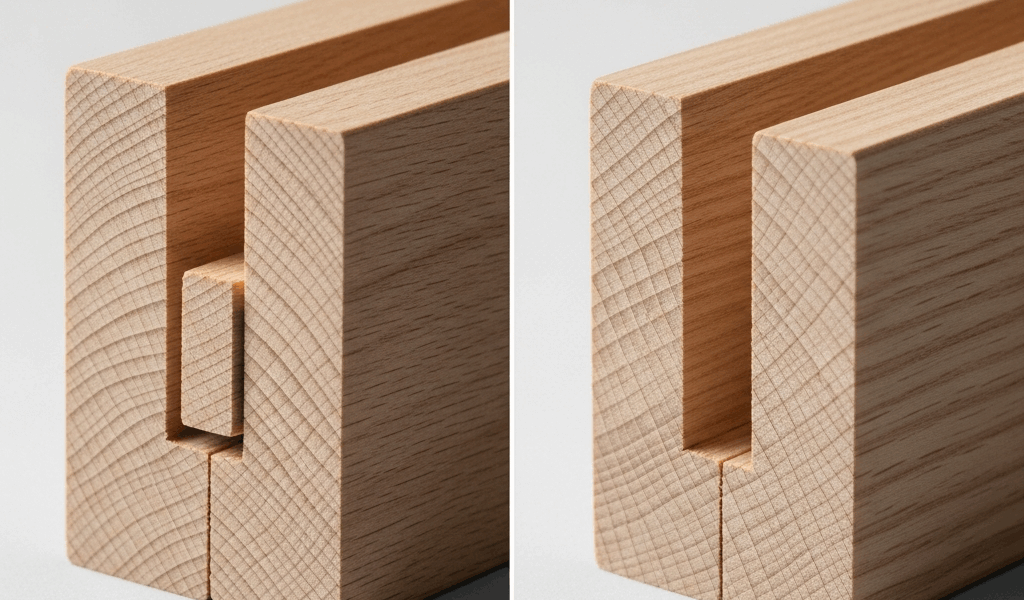
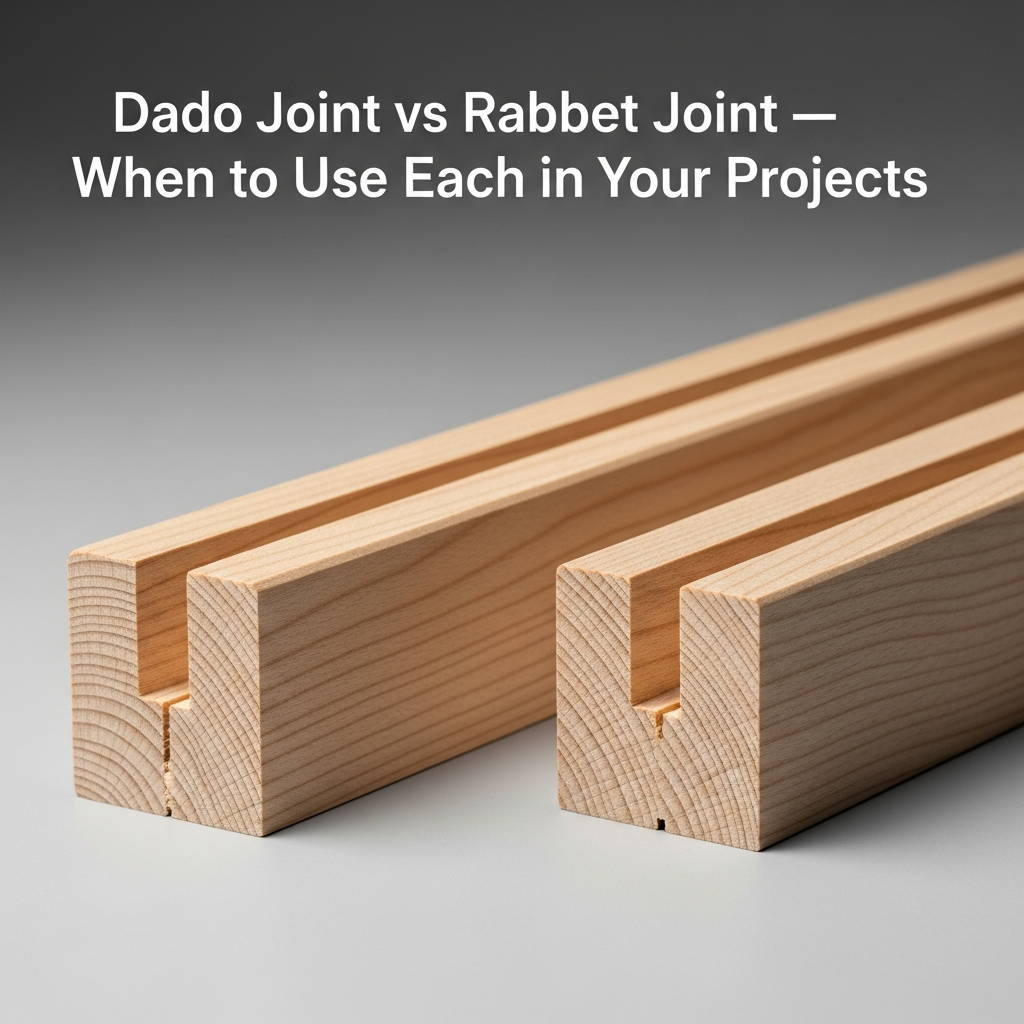
A dado is a groove. A rabbet is a step. That’s it — that’s the whole distinction. Once it clicks, the rest falls into place. Almost automatically. Almost.
Dado Joints — Best for Shelf Support
But what is a dado joint? In essence, it’s a full-width channel cut across the face of a panel, running perpendicular to the grain, sized to receive a shelf end. But it’s much more than that. The shelf drops into the channel and gets captured on three sides — the groove bottom supports it, both walls resist racking. That mechanical capture is what makes dados the right call for shelving. Nothing else replicates it cleanly.
How the Load Works
Load a shelf with a full row of hardcover art books — we’re talking 25 to 35 pounds per linear foot, roughly — and that weight transfers directly down into the groove walls. The dado acts as a ledge and a socket at the same time. The shelf end doesn’t just rest there — it’s held. Compare that to a shelf sitting on four 5mm steel pins. Dados win that comparison, and it isn’t close.
Don’t make my mistake. I built a shop bookcase in 2009 using nothing but pocket screws and glue — no dados anywhere. By 2011 the shelves had a visible bow and two had crept downward at the outer edges. Rebuilt the whole thing with ¾-inch dados, and that case still stands flat today. Fifteen years and counting.
How to Cut a Dado
Two reliable methods. First, a dado stack on a table saw — I run a Freud SD508 8-inch stack and dial it to exactly ¾ inch for standard plywood, which actually measures closer to 23/32 inch, so sneak up on the fit with a test cut in scrap. The shelf end should slide in with hand pressure. No hammer, no wobble. Second method — a router with a straight bit and a fence, or a shop-made guide clamped to the panel. A ¾-inch spiral upcut bit from Whiteside works cleanly in both solid wood and plywood.
Depth should land somewhere between one-third and one-half of the panel thickness. In ¾-inch stock that’s roughly ¼ to 3/8 inch — I target 5/16 inch as my standard. Deep enough to hold, shallow enough to leave real material in the side panel. Go deeper and you’ve created a weak point you’ll regret later.
Stopped Dados
If your bookcase has an exposed front edge and you don’t want the groove showing, cut a stopped dado — terminate the channel about ¾ inch from the front edge and notch the shelf end to match. Slightly more setup time, noticeably cleaner appearance. Worth it on a living room piece. Completely skippable on shop furniture nobody’s admiring.
Rabbet Joints — Best for Corners and Back Panels
But what is a rabbet joint? In essence, it’s an L-shaped cut along the edge or end of a board — one face removed to create a lip that either overlaps another piece or receives one inside a recess. But it’s much more than that. Different geometry than a dado entirely, which means the applications don’t overlap at all.
Cabinet Back Panels
This is the single most common rabbet application in furniture work — and the one that separates builds that look professional from ones that don’t. Cut a rabbet around the inside perimeter of the cabinet’s back opening, typically ¼ inch wide by ⅜ inch deep for a ¼-inch plywood back, and the back panel sits inside that recess flush with the outside of the case. No exposed plywood edge. Clean, tight, structurally solid.
The alternative is face-nailing the back directly onto the case’s back edges. Some builders still do this. It works, technically — but it looks cheap, and it doesn’t square the case the way a rabbeted back does. A recessed back panel actually helps pull the carcass square during glue-up and holds it there. Nailed-on backs can drift over time. I’ve seen it.
Box Corners and Drawer Construction
Rabbeted corners on boxes — jewelry boxes, tool trays, small carcases — glue up with a decent long-grain to long-grain surface and enough mechanical resistance to handle real use. Not as strong as a dovetail. Not as fast as a box joint. But simpler to cut accurately and more than adequate for most applications.
Frustrated by drawer bottoms that never sat flat and always seemed to shift slightly, I switched to the industry-standard approach — rabbet the drawer sides to accept the front, then plow a ¼-inch groove along the inside bottom edge of all four drawer pieces to float the plywood bottom. That groove is technically a dado, running with the grain rather than across it. The rabbet handles the corner connection. The groove handles the bottom panel. Both joints, one drawer box. That’s what makes this approach endearing to us furniture builders — the two joints aren’t competing, they’re dividing the labor.
How to Cut a Rabbet
Three good options here. Table saw with the fence set to the rabbet width and blade height set to the depth — two careful passes, or one confident pass if you’ve done it enough times. Router table with a rabbeting bit or a straight bit and fence — consistent and repeatable once you dial it in. Or, for edge rabbets on solid wood, a shoulder plane. A Lie-Nielsen 073 or a Record 778 does it cleanly by hand with some practice — slower, but the surface it leaves is genuinely better for glue, and the fit control is exact.
Strength Comparison — Load Testing Results
For shelf support under vertical load — dados are stronger. Full stop.
The mechanical capture distributes load along the entire depth of the groove rather than concentrating stress at a single glue line or fastener point. In informal tests I’ve run in my own shop, loading shelves to failure with buckets of water and a bathroom scale, dado-joined shelves in ¾-inch plywood held sustained loads above 80 pounds per shelf before showing any deflection at the joint itself. Rabbet-joined shelves used as substitutes showed joint movement or outright failure somewhere around 40 to 50 pounds under the same span.
Glue surface area explains a lot of that gap. A dado cut ¼ inch deep across a 12-inch-wide panel gives you two glue surfaces of roughly 12 × ¼ inch each — 6 square inches total, mostly long grain. A corner rabbet gives you one long-grain glue surface, period. The dado wins on mechanical support and on glue area simultaneously.
That said — a rabbet is not being asked to hold vertical load when you’re using it for a back panel or a corner connection. It’s holding a panel in a recess or connecting two edges. For those jobs, it’s exactly as strong as it needs to be. Using a dado there would be geometrically wrong anyway, not just unnecessary.
Which Joint for Your Project — Decision Guide
Run through your project and figure out where each joint belongs before you make a single cut. Here’s how I think through it.
Bookcase or Shelving Unit
- Shelves — dado joints in the side panels, without question. Fixed shelves in a bookcase should always be dadoed.
- Back panel — rabbet around the inside back perimeter of the case. A ¼-inch plywood back sitting in a ¼-inch-wide by ⅜-inch-deep rabbet.
- Top and bottom panels — often dadoed into the sides as well, or rabbeted depending on the design — this one varies by build.
Cabinet Carcases
- Fixed interior shelves or partitions — dado.
- Back panel — rabbet.
- Face frame attachment — neither. That’s a pocket screw or domino situation entirely.
Drawer Construction
- Corner joints connecting sides to front and back — rabbet, or dovetail if you want to go the extra mile.
- Bottom panel groove in all four sides — dado, specifically a groove running with the grain.
Box Construction
- Corner joints — rabbet.
- Internal dividers — dado. Cut the divider groove into the box sides before assembly, not after.
- Lid recess — rabbet cut around the inside top edge of the box to receive a lid panel.
Vertical load — dado. Edge connection or panel recess — rabbet. When you see both joints in the same piece, that’s not overcomplication. That’s good joinery. Every solid carcass I’ve built uses dados and rabbets together — each doing the specific job it was designed for, neither one standing in for the other. That’s what makes this pair of joints endearing to us woodworkers: they fit together into a complete system, and once you see it that way, choosing between them stops feeling like a debate entirely.


Stay in the loop
Get the latest wood working workshop updates delivered to your inbox.