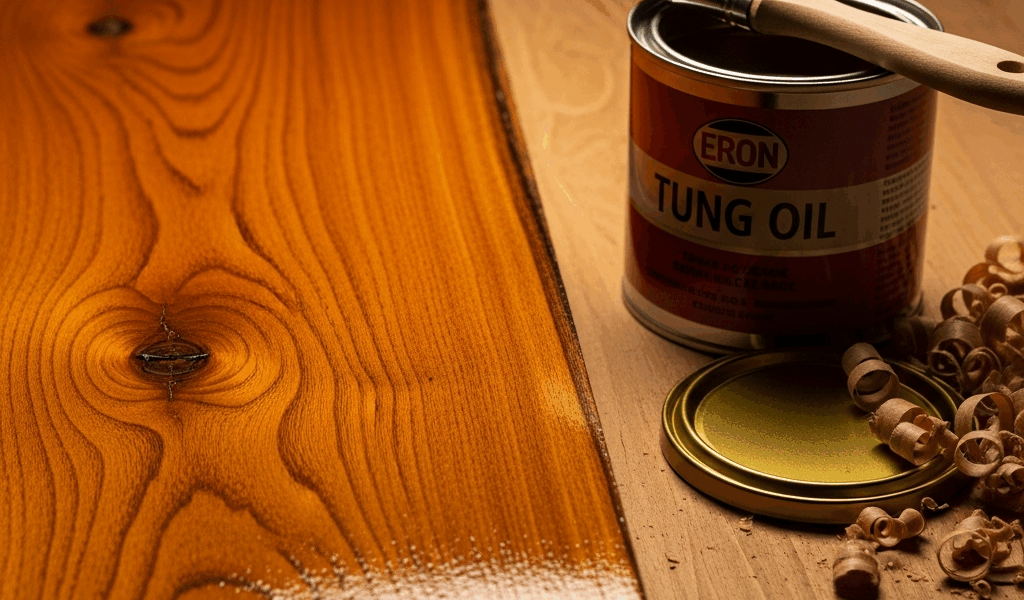
Tung Oil Finish — How to Apply It Right the First Time
Tung oil has gotten complicated with all the mislabeling and marketing noise flying around. Walk into any hardware store and you’ll find four or five products with “tung oil” somewhere on the label — and almost none of them are actually tung oil. I spent three years thinking I had this figured out before realizing I’d been treating two completely different products as though they were the same thing. They’re not. Not even a little bit.

As someone who’s finished everything from walnut cutting boards to full dining sets, I learned everything there is to know about the difference between pure tung oil and what the industry calls “tung oil finish.” The distinction wrecked my first few projects before I finally slowed down and paid attention. If you’re staring at a freshly milled board right now wondering what to grab off the shelf — this is the article I needed three years ago.
This article includes affiliate links. We may earn a commission at no extra cost to you.
Pure Tung Oil vs Tung Oil Finish — Not the Same Thing
But what is pure tung oil? In essence, it’s 100% natural oil cold-pressed from the nuts of the tung tree — nothing added, nothing removed. But it’s much more than that. It’s a finish with a centuries-long track record, a genuinely food-safe surface once cured, and the kind of natural depth that synthetic products spend their whole marketing budgets trying to fake.
Commercial tung oil finish products — Minwax, Formby’s, a dozen others — are blends. Varnish, petroleum solvents, chemical driers, and some amount of actual tung oil thrown in. The label doesn’t always tell you how much. Manufacturers engineer these products to dry fast and build protection quickly, which solves a real problem for people with deadlines.
Here’s the part nobody warns you about: I can open a can of Minwax Tung Oil Finish on a Monday morning and have a piece of furniture ready to use by Wednesday. With pure tung oil, I’m looking at a month-long commitment — minimum. Not an exaggeration. The full cure takes 30-plus days. Between each of the five to seven coats you’ll need, you’re waiting 24 hours. A cutting board finished in March genuinely isn’t ready for heavy use until May.
That’s what makes the distinction endearing to us woodworkers — it forces you to decide upfront what you actually value. Speed and protection, or patience and something that gets better with age.
Probably should have opened with this section, honestly. Most people don’t figure out this distinction until they’ve already bought the wrong product and watched their timeline fall apart.
How to Apply Pure Tung Oil
While you won’t need a full spray booth or professional finishing setup, you will need a handful of specific materials — and substitutions here tend to cause problems.
- Pure tung oil — I use Sutherland Welles, which runs about $28 for 16 oz at most specialty woodworking suppliers
- Food-grade citrus solvent like D-Limonene for thinning the first coat
- Clean cotton rags — old t-shirts work fine, cut into rough squares
- A small measuring cup or glass jar
- 400-grit sandpaper
- Nitrile gloves — pure tung oil does not wash out of skin easily, and I have the stained thumbnails to prove it
First coat — the thinning step is non-negotiable.
Mix pure tung oil with citrus solvent at a 50/50 ratio. This isn’t a suggestion. Undiluted tung oil on that first coat sits on top of the wood instead of soaking into it — you end up with a surface film instead of actual penetration. The citrus solvent thins it enough to let the oil travel deep into the grain where it does its real work.
Apply this mixture generously with a rag, working with the grain. You’re not trying for an even coat at this stage — you’re trying for saturation. Let it sit for 30 to 40 minutes while the wood absorbs what it needs, then wipe off everything that’s left. And I mean everything. Don’t make my mistake — I left excess oil sitting on the surface my first time, thinking more coverage meant more protection. What I actually got was a sticky, tacky finish that took three additional weeks and twice as much sanding to fix. The wiping step isn’t optional.
Set the piece aside for a full 24 hours after that.
Coats two through seven — this is the grind.
First, you should sand lightly with 400-grit paper between every coat — at least if you want a finish that actually feels smooth when you’re done. The surface raises slightly as it cures. Light scuffing flattens that back down and gives the next coat something to bond to. Wipe away all the dust before you do anything else.
For coat two onward, apply tung oil straight from the can — no dilution. Thin coat, 30-minute wait, wipe off the excess. That sequence repeats until you’ve done five to seven coats total. Decorative pieces can get away with three or four. Anything that sees actual use — a cutting board, a dining table, a wooden spoon — needs the full treatment.
The math works out to roughly two weeks of daily application before you’re even done putting on coats. Then you wait another 30 days for full cure. It’s a commitment. But the walnut cutting board I finished this way last year has developed a patina that no faster finish could replicate. The surface feels alive in a way that’s genuinely difficult to describe to someone who hasn’t held it.
How to Apply Tung Oil Finish Products
Commercial tung oil finish might be the best option, as furniture work with real deadlines requires a product that actually respects your schedule. That is because these blends already contain the solvents and driers that pure tung oil doesn’t — the manufacturer has done the chemistry for you.
What you’ll need is simpler here:
- Minwax Tung Oil Finish or equivalent — usually $12 to $18 per quart at any big-box hardware store
- Natural bristle brush or a lint-free rag — either works
- 400-grit sandpaper
- Drop cloth
- Gloves
Application is straightforward.
Apply a thin coat directly from the can — no thinning, no prep mixing. Brush or wipe it on, smooth out any drips immediately, and let it sit. Touch-dry in two to four hours. You can handle the piece after four hours without worrying about leaving fingerprints in the finish.
Once dry, sand lightly with 400-grit — technically optional according to most product labels, but I do it every time without exception. You’ll see fine dust from the finish itself as you sand. That’s expected. Wipe everything clean with a tack cloth before the second coat.
Apply a second coat exactly like the first. Some products push a third coat, and for anything that’ll see water or heavy use — a desk, a kitchen table — the third coat is worth doing. Two coats handle most furniture applications fine. Wait 24 hours after the final coat before the piece goes into service. Total elapsed time from opening the can to using the furniture: roughly 30 hours.
The finish keeps hardening over the following week, but it’s functional well before that.
Which to Choose for Your Project
The choice almost entirely comes down to timeline and what the piece is actually going to do in the world.
Pure tung oil makes sense for:
- Cutting boards and anything with food contact — it’s genuinely food-safe after full cure
- Wooden utensils, handles, anything you hold and use with your hands regularly
- Projects where natural patina over time is the whole point
- Any situation where you have six or more weeks before the piece needs to be used
Commercial tung oil finish makes sense for:
- Furniture with real deadlines attached
- Doors, trim, and architectural millwork
- Tables and desks that see moderate to heavy daily use
- Anything where water resistance matters more than natural feel
- Client work — apparently clients don’t love hearing they need to wait six weeks before sitting at their new dining table
I finished a walnut cutting board last spring using pure tung oil — seven coats, full cure, the whole process. It gets used almost every day. The surface has changed over the months in a way that feels earned. Would I use that same approach for a client’s dining table? Absolutely not. Different problem, different solution.
Common Application Mistakes
Having worked through both products across dozens of projects, I keep seeing the same errors come up.
Not wiping off the excess after each coat. This is the one that gets beginners every time with pure tung oil. The oil left sitting on the surface doesn’t cure properly — it stays gummy and strange-feeling for weeks. Remove all excess after every single waiting period. Every coat. Non-negotiable.
Going too thick on the first coat. Thick application on that initial coat actively prevents penetration. The 50/50 thinned mixture exists specifically to get the oil down into the grain rather than sitting on top of it. Thick first coats just waste product and create problems for coats two and three.
Applying subsequent coats too heavy. Even after the first coat, thin is always better than thick. Too much oil at once wrinkles as it cures — you end up with an uneven surface that requires sanding back through the wrinkled area, which means you’ve largely cancelled out the coat you just applied.
Skipping the between-coat sanding. This new idea — that sanding is “optional” — took off several years later and eventually evolved into the bad habit enthusiasts know and regret today. Skipping it produces a noticeably rougher final surface. The light scuffing with 400-grit ensures each coat bonds to the previous one. The difference in how the finished piece feels is obvious if you run your hand across it.
Switching products partway through. I’ve seen this happen — someone starts with pure tung oil, gets impatient around coat three, switches to a commercial blend to speed things up. The behavior of the two products is incompatible enough that the results are unpredictable. Pick one. Commit to it before you open either can.
Applying tung oil correctly — whichever type ends up in your hand — comes down to understanding what the product actually does and working with it instead of against it. Pure tung oil is a commitment to patience and something that improves with time. Commercial tung oil finish is a practical tool for people with actual deadlines. Neither is superior. They’re just different answers to different questions.



Stay in the loop
Get the latest wood working workshop updates delivered to your inbox.