Why Circular Saws Bind in Wood
Circular saw binding in wood has gotten complicated with all the misinformation flying around—but here’s the thing: binding rarely means something’s broken. I’ve spent enough time at the table saw station watching people wrestle with their tools to know this problem creates genuine frustration.
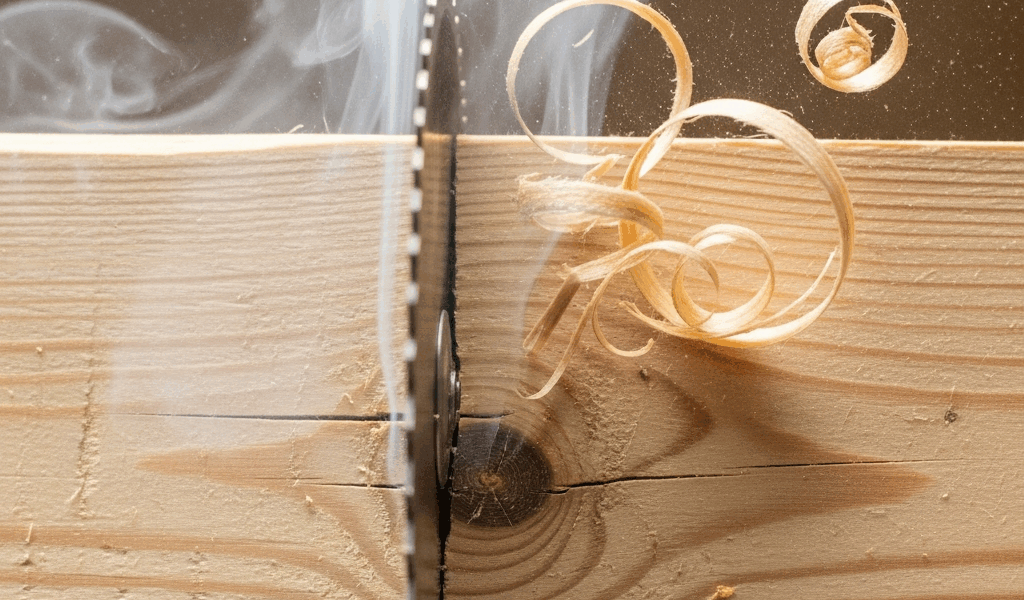
The mechanical reality is straightforward. When your blade angle is off, even by a few degrees, you’re forcing the teeth to approach the wood at the wrong angle. Think of it like squeezing a wet bar of soap between your fingers — the pressure pushes sideways instead of straight through. That sideways pressure is what causes binding. Your motor has to work against that resistance, the blade heats up, and the wood around the cut starts expanding from friction heat. Suddenly what was a clean path gets tighter. The blade can’t move forward, so it stops. Or worse, it kicks back.
Feed speed is the second culprit. Push too slowly and you’re holding that blade against the wood long enough for heat and friction to swell the material around your cut. Push too fast and the blade teeth can’t evacuate wood chips efficiently — they jam up like a clogged gutter. Wood grain direction ties into this too. When you’re cutting perpendicular to the grain, the wood fibers resist your blade’s sideways motion more aggressively. The blade wants to wander, and if your hand pressure isn’t perfectly perpendicular to the cut line, the blade gets pushed sideways into the kerf walls. That’s binding.
Check Your Blade Angle and Depth First
Probably should have opened with this section, honestly. Most binding problems vanish once you verify two measurements.
First, check your blade depth. Your circular saw blade should cut approximately 1/4 inch below the bottom surface of your workpiece—no more. If your blade is dropping more than 1/2 inch below the wood, you’re exposing too much blade length to side pressure. That extra exposure acts like a lever, multiplying any sideways forces. Get your square, place your saw on the wood (unplugged), and look at the gap between the lowest teeth and the underside of your stock. Here’s the simple setup: place a piece of scrap wood under your saw’s base, mark where the blade teeth are, then measure.
Second, verify your blade is perpendicular to your base plate. This is where most people’s binding problems originate — I’m apparently the type who discovered this the hard way. Take an adjustable square or a 12-inch combination square, place it flat against your saw’s base plate, and bring the blade into contact with the upright portion of the square. You should see zero gaps. If the blade tilts at 89 degrees or 91 degrees, that slight angle multiplies over the length of your cut. The blade steers itself sideways into the kerf wall.
If your blade isn’t 90 degrees, loosen the bevel adjustment on your saw base. Most modern circular saws have a cam lever or a Phillips head bolt under the motor housing. Adjust until that square sits flush, then tighten. Take a test cut on a piece of pine. The difference is immediate — you’ll feel it the second you start cutting.
While you’re inspecting, look at your blade itself. A warped or bent blade won’t sit true even if your base plate is perfect. Spin the blade by hand (with the saw unplugged) and watch for wobble. If the blade looks like it’s doing a hula hoop motion, replace it. You can also hold a pencil point steady near the blade’s edge as it rotates — if the gap between pencil and blade tooth changes, the blade is bent. A warped blade is not worth fighting through. Trust me on this one.
Adjust Your Feed Rate and Hand Position
Operator technique causes more binding problems than equipment failure. I learned this the hard way during a kitchen cabinet job where I was pushing my saw through maple like it owed me money. The binding got worse, the saw stalled twice, and I nearly threw it across the garage — don’t make my mistake.
You need to feel your way into the wood. Start the saw, let it reach full speed (listen for that steady high-pitched whine), and place the blade just barely touching the cut line. Don’t plunge. Let the saw do its work. Your job is to guide, not force. The resistance should feel minimal. Your arms shouldn’t be straining.
The moment you feel the blade grab or hear the motor strain, stop pushing. Back up. Let the blade clear. This is the feedback loop most people miss — instead, they push harder. That makes the friction heat worse, the wood expands more, and the binding intensifies until the saw stalls or kicks back. It’s like trying to force a stuck drawer. The harder you push, the more stuck it gets.
Your hand position matters too. Both hands should press straight down on the saw body, keeping pressure directly perpendicular to your workpiece. Your back hand guides the rear of the saw; your front hand keeps the base plate flat and prevents twisting. If you’re angling your wrists or letting the saw tilt side-to-side, the blade angles inside the kerf and binding happens. Keep everything square.
Speed is the variable you control — at least if you want smooth cuts. For hardwoods, move slower than you would for pine. For thick material, move slower than for thin stock. For cross-grain cuts, slower still. Listen to your motor. A healthy cut sounds steady. A binding cut sounds like the motor’s struggling or stuttering. When you hear that, you’re already too far. Develop the habit of releasing pressure and letting the blade coast before it stalls.
One practical safety note: kickback is a real concern with circular saws, and it happens fastest when the blade binds and suddenly releases. Keep your fingers and thumbs well away from the blade path. Never reach across the blade. Never stand directly in line with the blade. If you’re clamping your workpiece (and you should be), make sure the clamps don’t interfere with the saw’s base plate movement.
Read the Wood Grain Before You Cut
This is what separates experienced makers from people fighting their tools — grain direction changes how your blade interacts with the material, and ignoring it guarantees binding on harder woods.
Look at your workpiece edge-on. Grain runs from one end to the other like a river. When you cut perpendicular to the grain direction (a cross-grain cut), the wood fibers resist sideways motion. A grain-direction cut (rip cut) lets the blade slide through the natural fiber pathways. Cross-grain cuts bind more easily because the wood pushes back harder.
Here’s what this means in practice: if you’re cutting a 12-inch-wide board and the grain lines run left-to-right, your blade wants to wander toward one grain direction or the other. If you feed from the wrong end, you’re cutting “into” the grain, and the fibers are actively pushing the blade sideways. If you feed from the correct end, you’re cutting “with” the grain, and the fibers separate more willingly.
On pine and softer woods, this barely matters. On oak, maple, and cherry, it’s the difference between a smooth cut and a battle. Ideally, you want to feed the workpiece so the blade cuts “downhill” along the grain direction, not “uphill” against it.
Before you make your actual cut, do a test pass. Score the line lightly with your blade at quarter-inch depth — don’t try to cut all the way through. Feel how the blade behaves. Does it track straight? Does the motor struggle? If the binding shows up in this test cut, flip your board 180 degrees and try from the other end. One direction will feel smoother. That’s your feed direction.
When to Replace the Blade or Motor
After you’ve nailed your blade angle, depth, feed rate, and grain direction, binding might still occur. That’s when you look at parts.
A dull blade exhibits binding differently than a sharp blade. Dull teeth don’t cut efficiently, so they generate more friction heat. The wood expands around a dull blade faster than around a sharp one. You’ll notice the cut feels sluggish even at normal feed speeds, and the kerf fills with sawdust that doesn’t evacuate cleanly. A sharp blade costs $15–40 for a quality carbide model — that’s better than wearing out your motor. A dull blade makes every cut worse and your motor works twice as hard.
Motor wear shows up as binding that happens even on simple cuts with correct technique. The blade wobbles slightly even though everything’s properly adjusted. Or the motor lacks power — it bogs down too easily. If your saw is more than five years old and sees regular use, motor bearings can wear enough to allow blade wobble. Replacing a motor assembly costs $60–120 for a quality saw, versus $200–400 for a replacement saw if you go cheap and it fails mid-project.
The honest reality: most binding problems solve themselves with technique adjustments. Replace your blade once every 500–1000 cuts depending on material hardness. Check your blade angle every month if you’re cutting daily. These two habits eliminate 95% of binding issues before you ever consider motor replacement — I’ve apparently found what works for me, and this routine has never let me down while other approaches never worked.


Stay in the loop
Get the latest wood working workshop updates delivered to your inbox.